Tethering: A Simple Tool for a Calmer Puppy
When we bring home a puppy, we think about crates, baby gates, exercise pens, and training. But there's another simple management tool I love for puppies and adolescent dogs:
The tether.
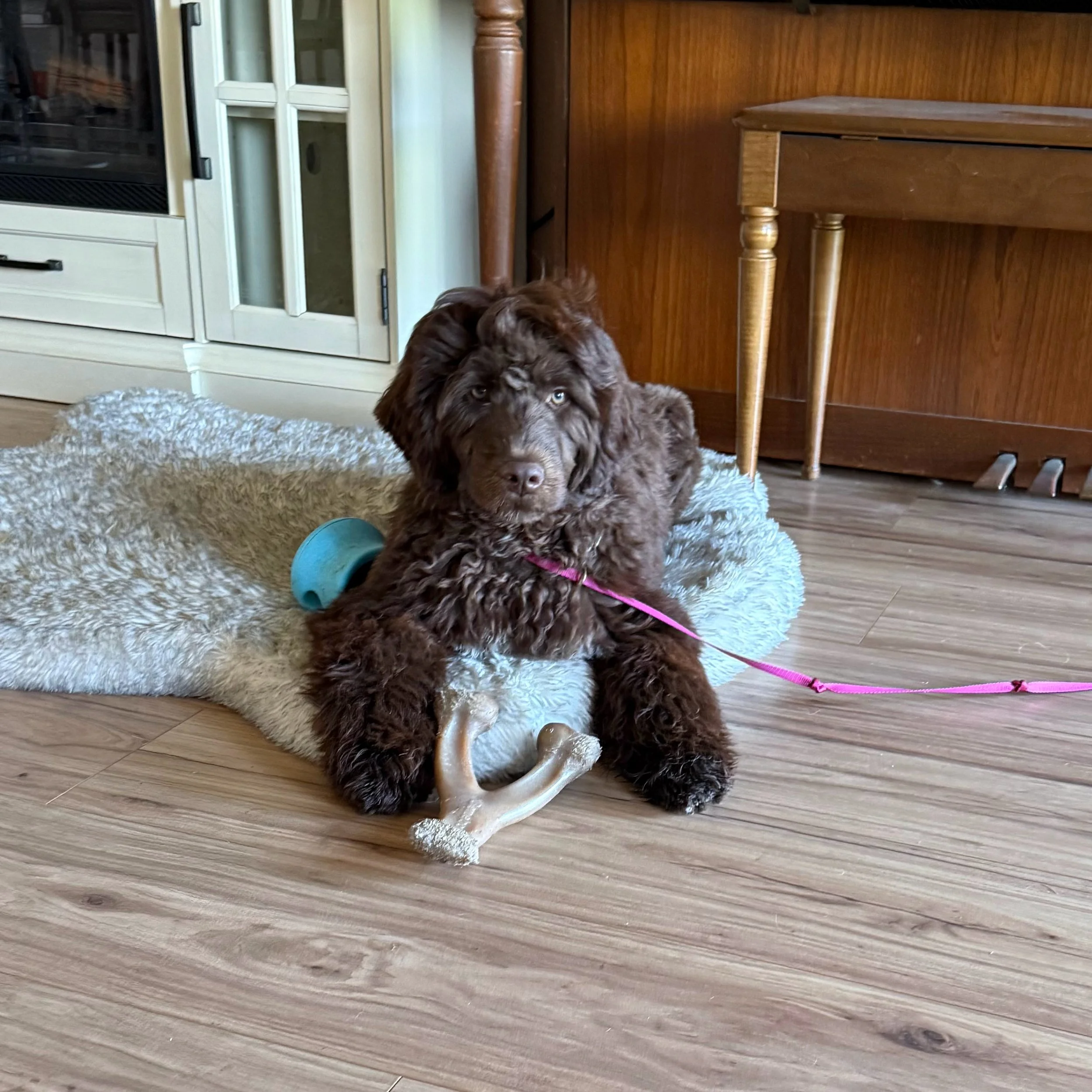
Tethering simply means keeping your puppy on a leash while you're home. The leash can be attached to you or, under direct supervision, secured to a safe, sturdy location nearby.
The goal isn't to restrict your puppy all day. It's to teach a skill many young dogs desperately need: How to do nothing.
Teaching an "Off Switch"
Some puppies will play until they fall over, and adolescent dogs can be even worse. They're bigger, stronger, have more stamina, and often don't know when it's time to stop.
When a young dog has free rein of the house, there's always something to do—a shoe to steal, a person to follow, another dog to bother, or a window to investigate.
Sometimes what looks like a dog who needs more exercise is actually a dog who needs to learn how to settle.
After your puppy has had exercise, potty time, and some interaction, tether him near you with a comfortable bed or mat and go about your business.
You don't necessarily need to entertain him. That's part of the lesson.
Eventually, many puppies realize nothing exciting is happening, sigh, lie down, and relax.
Building Frustration Tolerance
Young dogs don't automatically know how to handle hearing, "Not right now."
They want to follow you. They want the toy. They want to play with the other dog. They want to investigate whatever you're doing.
A tether provides a safe way to practice not immediately getting what they want.
Your puppy may initially pull, whine, or protest. As long as his needs have been met and he isn't truly distressed, a little frustration is okay.
He's learning an important life lesson:
"I don't always get to do exactly what I want, and I'm still okay."
Giving Your Adult Dogs a Break
This is one of my favorite reasons to tether puppies in multi-dog homes.
Puppies can be incredibly annoying!
They climb on adult dogs, bite their ears, steal toys, interrupt naps, and follow them when they're clearly trying to get away.
Appropriate communication between dogs is normal, but your adult dog shouldn't have to spend the entire day correcting your puppy.
A tether allows your puppy to be part of the family without having unlimited access to the other dogs. Your adult dog can walk by without being tackled or lie down without a puppy landing on his head.
Most importantly, your adult dog learns that you'll protect his space so he doesn't always have to.
Preventing Bad Habits
Every time your puppy steals something, jumps on the older dog, chases the cat, or chews the rug, he's practicing that behavior. And dogs get better at the things they practice.
A tether lets you prevent many of those behaviors without spending your entire evening saying:
"No. Leave it. Get down. Come here. Drop that!"
Instead of constantly correcting unwanted choices, you simply prevent many of them from happening. That's not cheating. That's good management.Make Tethering Part of Everyday Life
Don't wait until you desperately need your wild adolescent dog to settle.
Practice while you're watching television, working at your computer, cooking dinner, or talking with someone. Start with short periods and make it easy for your puppy to succeed.
Tethering should never replace exercise, enrichment, play, or training, and a tethered puppy should always be supervised. Make sure the leash can't become tangled and consider using a well-fitted harness, especially with a puppy likely to pull against the leash.
Tethering should never be punishment. We want it to mean calm, safe downtime near the family.
Learning to Do Nothing Is a Skill
We spend a lot of time teaching puppies how to do things - sit, down, come, stay, leave it.
But one of the most valuable things we can teach them is how to do nothing at all.
You don't have to play with every dog. You don't have to follow every person. You don't have to be entertained every minute you're awake.
Sometimes everyone else is busy, and your job is simply to relax.
A tether can help puppies and adolescent dogs learn that lesson while protecting our older dogs, preventing unwanted habits, and building frustration tolerance.
Learning how to settle is a skill - and it's one your puppy will use for the rest of his life.
At Moon Dog Training, our private lessons are designed around your individual dog and the specific challenges you’re experiencing. We work one-on-one to teach practical replacement skills, help your dog stay under threshold, and gradually build confidence around their triggers. Because every dog - and every family - is different, private training allows us to adjust the environment, exercises, and pace to set your dog up for success.