Does Your Dog Really Need 18 Hours of Sleep a Day?
Why rest may be the missing piece in your dog’s behavior plan
You may have heard that dogs need 18 hours of sleep a day. Is that actually true? Sometimes, but not for every dog. Puppies can easily sleep 18–20 hours in a 24-hour period, and senior dogs may also sleep considerably more than they did when they were younger. Healthy adult dogs generally need less, and individual needs vary based on age, activity level, health, breed and temperament.
So, I don't think we need to start keeping sleep logs and worrying because our adult dog only slept 14 hours yesterday. However, there is an important message behind that 18-hour claim: many dogs need far more rest and downtime than we give them. As a trainer who works extensively with anxious, excitable and reactive dogs, this is something I pay a lot of attention to.
Have We Become Too Good at Entertaining Our Dogs?
Over the years, we've learned a lot about canine enrichment. We know dogs need exercise and opportunities to use their brains, so conscientious owners take their dogs for walks, enroll them in daycare, buy puzzle toys, stuff Kongs, schedule playdates, teach tricks, play fetch and find increasingly creative ways to "wear them out."
Those things can all be wonderful, but sometimes we accidentally create a dog whose entire day is filled with activity. Morning walk, breakfast puzzle, daycare, training, fetch, another walk, snuffle mat, chew, more play - and then we wonder why this dog can't just relax.
Sometimes it's because we've never actually taught them how.
One of the most common pieces of advice given to owners of high-energy dogs is, "You need to tire him out." So the owner exercises the dog more. The dog gets fitter and develops more stamina, so now he can exercise longer. The owner increases the exercise again. Before long, we've created a canine athlete who can hike for miles and STILL comes home looking for something to do.
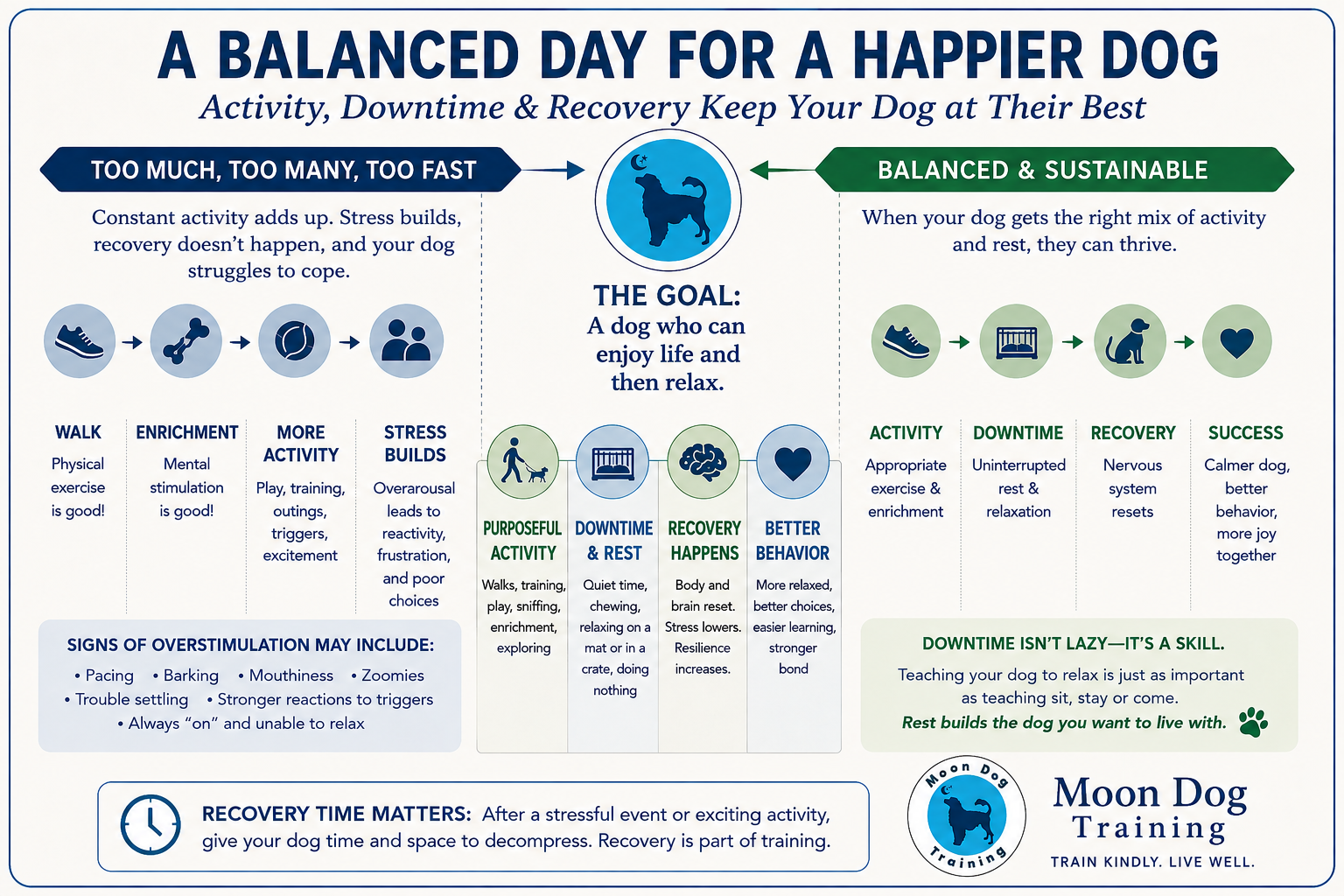
Physical exercise is important, but exercise and relaxation are two different skills. A dog can be physically tired and still have difficulty mentally switching off. For some dogs, particularly highly aroused, anxious or reactive dogs, continually adding stimulation can actually make settling more difficult.
An Overtired Dog Doesn't Always Look Tired
This is where owners often get fooled. We expect a tired dog to lie down, yawn and fall asleep. Instead, an overtired or overstimulated dog may pace, bark at every little noise, become mouthy, get the evening zoomies, constantly demand attention, react more strongly to things outside, follow you from room to room or simply seem unable to shut his brain off.
Because the dog appears to have more energy, our instinct is often to think, "He needs another walk." Sometimes what he actually needs is a nap.
Think about a toddler who missed a nap. They don't always become quiet and sleepy; sometimes they become complete lunatics. Puppies can be very similar. If your puppy suddenly turns into a tiny piranha every evening - running around, grabbing clothes, biting hands and seemingly forgetting everything you've taught him - before adding more activity, ask yourself how much that puppy has actually slept that day.
Arousal Adds Up
Every experience your dog has affects his nervous system, and even positive excitement is still arousal. A dog may go for a walk and encounter several dogs, bark when a delivery person comes to the door, have visitors arrive, chase a squirrel in the backyard and then attend training class that evening. None of those things individually has to be "bad," but together they can make for a very full day.
Without enough opportunity to recover, a dog's ability to cope with the next exciting or stressful event may decrease. This is part of what we talk about with trigger stacking. Sometimes the thing that finally sends a dog over threshold seems insignificant, but it wasn't necessarily that final event - it was everything that came before it.
Rest gives the nervous system an opportunity to come back down.
Sleep Isn't the Only Thing That Counts
I also don't like getting overly hung up on an exact number of hours because sleep and downtime aren't quite the same thing, and both are important. Your dog doesn't have to be unconscious for rest to be valuable.
A dog lying comfortably on a bed while you watch television is resting. A dog quietly chewing something in a crate is having downtime. A dog stretched out under your desk while you work isn't being neglected because you're not entertaining him.
In fact, the ability to simply exist without needing constant entertainment is an incredibly important life skill. I want my dogs to understand that sometimes we're training, sometimes we're playing, sometimes we're going somewhere exciting - and sometimes absolutely nothing is happening. That's okay.
Rest Is Especially Important for Reactive Dogs
This becomes particularly important when we're working with anxious or reactive dogs. If your dog had a difficult walk this morning, encountered several triggers, barked at the UPS driver and then had people working in the house, I may not want to add another stimulating outing that evening simply because "he needs exercise." His nervous system may need an opportunity to recover.
When training reactive dogs, we spend a lot of time teaching them what to do around triggers: look at the handler, disengage, move away, go to a mat or perform another familiar behavior. Those skills are important, but I also care tremendously about what happens afterward. How quickly can the dog come back down? Can he relax? Can he sleep? Can his body return to baseline before we ask him to handle something else?
Recovery is part of training.
Don't Confuse Rest With Lack of Enrichment
None of this means dogs should spend their entire lives sleeping on the couch. Dogs still need opportunities to walk, sniff, explore, play, train, chew, problem-solve, socialize appropriately and use their bodies and brains.
The goal isn't less activity. The goal is balance.
If your dog struggles to relax, start deliberately building quiet time into the day. After a walk, you don't necessarily need to immediately pull out a puzzle toy. After an exciting training class, your dog probably doesn't need another round of fetch. After a busy outing, give him somewhere comfortable and quiet to decompress.
Crates, gates, exercise pens, mats and quiet rooms can all be useful depending on the individual dog. We can also reinforce calm behavior when we see it instead of only interacting with our dogs when they're actively asking us for something.
Most importantly, don't feel guilty when your dog is doing absolutely nothing. You do not have to entertain your dog every minute he's awake.
So, Does Your Dog Need 18 Hours of Sleep?
Maybe. A young puppy may need that much or even more, while an adult dog may need considerably less. That's why I don't think "18 hours" should become another magic number dog owners feel pressured to achieve.
Instead, I think there's a better question to ask:
Does my dog have enough opportunity to truly rest and recover?
If your dog can enjoy walks, training, play and enrichment and then comfortably settle afterward, you're probably finding a healthy balance. But if your dog's life has become a never-ending schedule of exercise, daycare, enrichment, training and play because you're desperately trying to "tire him out," consider whether more activity is really what he needs.
Sometimes your dog doesn't need another walk, another puzzle or another game.
Sometimes he just needs a nap.
Giene Keyes
Moon Dog Training 🐾
Giene Keyes is the owner of Moon Dog Training, where she helps dogs and their people build better lives together. With over 30 years of experience, she specializes in manners and behavior challenges, working with families, vets, shelters, service dog organizations and rescues across Southern Wisconsin. Giene is a Certified Professional Dog Trainer, an AKC Canine Good Citizen Evaluator, Licensed 4-H Dog Show Judge and a published author. She also raises and shows Portuguese Water Dogs and Lagotti Romagnoli. She loves showing just how clever and capable our dogs (and even chickens and pigs!) can be.
© Moon Dog Training, LLC